
Today my son lost his name. These things do happen, even though it's just a little less improbable than losing one's shadow.
The name he lost was mine, and the one he was given instead, whether we like it or not, is his father's.
Before his big sister was born, my husband and I made a deal: if it's a girl, she gets his name, if it's a boy, he gets mine, and the second child, boy or girl, gets the other parent's name. We preferred that to the double barrel option as we thought this just wasn't sustainable across generations - and, given our names, would just sound weird. So we ended up with a two-name family (as opposed to a three-name family if we'd gone for the double-barrel option and each kept our own), and the names are equally distributed. We didn't mind the kids not having the same name as each other: it's not like they're likely to forget they're brother and sister, and none of us need a name to know that we belong together, so this worked for us.
But, it's not legal. At least in France, where a child born before 2005 must take his or her father's name if the parents are married. This is a remnant of the Napoleon code of law, which took it upon itself to tell French families exactly what they should look like. Of course, there's been some changes since. Children born after 2005 may take their mother's name, but on condition that their siblings take it too. So there's no way we could have what we wanted.
Except we did: because we weren't married when the children were born, and because no one could work out that what we did wasn't legal until the records were computerised. So when I went to get Max's passport renewed, I was told that his last name had changed. And there is nothing I can do about it. My nine-year-old autistic son, who's just learnt to say his full name, is going to have to learn a new one.
Well, there's a couple of things we can do about it. We can have him take a 'nom d'usage' which is the same sort of thing as I would be allowed to have if I wanted to take my husband's name. (So ironically, the French law does not allow me to take my husband's name officially, so I cannot have the same name as my children anyway). The 'nom d'usage' cannot be my name, but has to be a double barrel name with my husband's name coming first. This will be recorded on passports etc, but his official name stays his father's and is also recorded on his passport.
As far as I can see, there isn't the slightest bit of a reason why this should be so. The requirement that siblings have the same name is ridiculous at best. Increasing, families are made up of children who don't share both parents (or any, but still consider each other brothers or sisters), so the requirement can't possibly apply to them: if you don't have the same father, and your mother married twice, then by (French) law, you can't have the same name. So the law is in fact designed so as to emphasise the difference between children in 'traditional' and reconstituted families. How nice is that?
The other thing we can do about it is get Max a UK passport, to which he is probably entitled to in his own name. We'll just have to try that. It seems the French law, so concerned that (legitimate) children should have the same name as their brothers and sisters, isn't bothered that one child should have different names in different countries.
In the meantime, I feel like we have strayed in a Wilkie Collins novel, and the only reason I'm not ditching French nationality for both children and myself is because we get a better deal from the French school they go to if they're French.
02/03/2012

29/02/2012
friends
This is my picture for week 93 at Tara's gallery.
Please share lots of friendships here http://stickyfingers1.blogspot.com/search/label/The%20Gallery

Please share lots of friendships here http://stickyfingers1.blogspot.com/search/label/The%20Gallery

06/01/2012
Boys and girls at play.
There's been a lot of talk lately in the UK, and everywhere on the internet, about the gender division of toys. Hamleys recently re-organised their toys according to interest, rather than gender. This was shortly after their headquarters were contacted by feminist blogger Delilah, who pointed out that their 'girl' and 'boy' floors smacked of gender apartheid. Of course, the change wasn't received everywhere with enthusiasm: still quite a few people appear to believe that girls are 'hard-wired' to prefer anatomically impossible dolls and pink tea-sets, whereas boys, if left to themselves, will choose cars and soldiers. This, in spite of all the hard work people like Cordelia Fine have been doing in recent years to explain why this isn't so in words of two syllables or less. Some people's brains are 'hard-wired' it seems, not to understand. But for those who do understand how hard it is to see what a child, no matter how young, prefers 'by nature', because their preferences are formed by their environment from the time they are babies, and because it's impossible for even the best, gender equal parents, to control more than a tiny part of that environment, it is time to take the debate further.
What toys you buy at the shop represents only part of a child's play activities, we all know that. A child is as likely, more likely maybe, to play successfully with a cardboard box and a bit of string than with the latest Christmas presents. This is good, of course, it helps their imagination and our finances. But it has a darker side. Many parents will say that although they would never dream of buying their sons toy guns, the boys still found ways of playing at killing each other, with sticks, with their fingers. Boys will be boys will be warriors. Girls will be girls will be mothers. With teddy bears, paper dolls, pets or small siblings.
I have nothing against playing mother. It is a fine occupation, and one which I would encourage more in little boys. Too often I have seen boys laughed at or chastised for pretending to perform domestic tasks, pushing a pram, wearing an apron, etc. It seems that little girls are 'by nature' designed to play these games, where nature means the approval of parents, peers, teachers and everyone else they might encounter, not to mention that all powerful influence, the little girl on the advert, looking at you from the tv screen, posters on bus shelters and the boxes in the toy shops. It is clear that if you want to succeed in life, you should do as she does.
But what of the boys who would play war? What of their parents who are 'powerless' to do anything about it, because, after all, they don't buy toy guns? Warring is a very powerful experience, they say - it's you and your team against the rest, it grabs all your instincts and emotions, magnifies them, focuses them - it's part of the human experience. I think I know what they mean. When on a couple of occasions, as a child, I have been at war, against indians, extra terrestrials, etc., I have felt the exhilaration, the sense of belonging, of being out of myself. Mostly, the excitement comes from the sense that you're out to kill, that you're unbound, that you can really hurt someone, even if it's only pretence.
So, great, you think it's harmless and enjoyable to let your kids pretend they're killing other human beings. How about letting them play rape, or torture? These are, after all, real things that go on in wars just like the fighting. And if you want your play to be more unisex, and to include kids who're not so good at running, say, then you can let them play the rape or torture victims. That way it's more realistic and more inclusive. It can be quite varied and imaginative as well. If you're in quiet surroundings and there's just a couple kids, they can play date rape. If there's one girl and a bunch of boys, they can play gang rape, with a couple of boys holding down the girl while the others take it in turns to pretend to rape and beat her. Sure, it's disgusting. I'm not happy with myself for writing it down, even. But is it really that much worse than letting kids pretend to shoot each other with the kind of weapons that will cause major destruction to the human body, and to re-enact horror scenes that take place daily in not so distant parts of the world, involving children not much older than themselves?
Can't we just say no?
What toys you buy at the shop represents only part of a child's play activities, we all know that. A child is as likely, more likely maybe, to play successfully with a cardboard box and a bit of string than with the latest Christmas presents. This is good, of course, it helps their imagination and our finances. But it has a darker side. Many parents will say that although they would never dream of buying their sons toy guns, the boys still found ways of playing at killing each other, with sticks, with their fingers. Boys will be boys will be warriors. Girls will be girls will be mothers. With teddy bears, paper dolls, pets or small siblings.
I have nothing against playing mother. It is a fine occupation, and one which I would encourage more in little boys. Too often I have seen boys laughed at or chastised for pretending to perform domestic tasks, pushing a pram, wearing an apron, etc. It seems that little girls are 'by nature' designed to play these games, where nature means the approval of parents, peers, teachers and everyone else they might encounter, not to mention that all powerful influence, the little girl on the advert, looking at you from the tv screen, posters on bus shelters and the boxes in the toy shops. It is clear that if you want to succeed in life, you should do as she does.
But what of the boys who would play war? What of their parents who are 'powerless' to do anything about it, because, after all, they don't buy toy guns? Warring is a very powerful experience, they say - it's you and your team against the rest, it grabs all your instincts and emotions, magnifies them, focuses them - it's part of the human experience. I think I know what they mean. When on a couple of occasions, as a child, I have been at war, against indians, extra terrestrials, etc., I have felt the exhilaration, the sense of belonging, of being out of myself. Mostly, the excitement comes from the sense that you're out to kill, that you're unbound, that you can really hurt someone, even if it's only pretence.
So, great, you think it's harmless and enjoyable to let your kids pretend they're killing other human beings. How about letting them play rape, or torture? These are, after all, real things that go on in wars just like the fighting. And if you want your play to be more unisex, and to include kids who're not so good at running, say, then you can let them play the rape or torture victims. That way it's more realistic and more inclusive. It can be quite varied and imaginative as well. If you're in quiet surroundings and there's just a couple kids, they can play date rape. If there's one girl and a bunch of boys, they can play gang rape, with a couple of boys holding down the girl while the others take it in turns to pretend to rape and beat her. Sure, it's disgusting. I'm not happy with myself for writing it down, even. But is it really that much worse than letting kids pretend to shoot each other with the kind of weapons that will cause major destruction to the human body, and to re-enact horror scenes that take place daily in not so distant parts of the world, involving children not much older than themselves?
Can't we just say no?
05/01/2012
School days, blood pressure days.
It started when he was four. Some days, he just didn't want to go to school. We'd have to carry him kicking and screaming into the school bus, knowing that he'd probably be allright once he got there. The kicking and the screaming was always for us only, with other people, he would be calm.
Then he got a bit older, and a bit bigger. Carrying him kicking and screaming no longer was an option. Once he'd started big school, the screaming would begin at 6.30 in the morning, getting up time, not wanting to put clothes on time. No longer for our ears only, it woke up the neighbours. Some days we'd manage to make him go, some days not, and then, we'd have to make a fast decision as to who would stay at home with him, whether we could get a last minute childminder to come, whether we could afford it. Then we'd have to find time to make up the work we'd missed, somehow, find the money to pay for the extra childcare.
Really not knowing what to do, I contacted a forum for autistic people and their family. What do you do when you child won't go to school? The responses were not helpful. How dare you keep your child away from school, they asked? Would you allow a non-autistic child to miss school? Do you think his education doesn't matter because he's autistic? Why don't you just tell him he's got to go?
I pictured myself telling him, over the screaming. At the time he was just beginning to talk, and mostly in Turkish, at that, a language I had no command of. I felt powerless. Another person advised me to make sure he had an unpleasant day if he stayed at home: no toys, no videos, just work. I didn't even try it out. Max in an worked up, not wanting to go to school state, was a head banger. At the slightest contradiction, he would begin to scream at the top of his voice and bang his head hard, on the floor, on the wall, on the furniture. I couldn't let that happen. I had to pacify him. Just do it, they'd said. Don't let him bang his head, they'd say. I couldn't even begin to imagine how it would be done.
Then in the second semester it stopped. He started to go school every day, or nearly, quite happily. We became used to having our days to ourselves, free to go about our work, and with a little bit of time spare at lunchtime to get together, my husband and I, to discuss strategies for the following day, just in case something went wrong. Often we used that time also to discuss how to help Max in other ways. We decided to keep him from school one day a week, Friday, so he could go to his special ed. classes in the afternoon and not be too knackered. We worked out how to use social stories to communicate with him better and help him deal with his anxieties. We found a way of getting help for him in the school, even though there was no real provision for that kind of thing here.
Over the following year, we had some scares, some nervous moments, he did miss school a few times, but we were able, mostly, to write it off as him not being quite well: a lot of autistic kids aren't great at recognising when they're sick, or communicating it. So we would assume he was and he'd go back the next day. On the whole he had a great year. He changed a lot, he learned a lot.
Then it started again this November. At first, we'd think he was sick. And he was, at least some of the time: we were all plagued by some nasty colds that just wouldn't go away. But, now more verbal, he made it very explicit that he did not want to go to school. He no longer wanted to work, get up in the morning, he was going to stay home, play and draw. A couple of times we managed to drag him to the school bus. Then we got a phone call from the driver saying he wouldn't come out to go into the school building. The teachers managed to coax him out, but Max didn't do much that day, and the next day, he stayed home.
This dragged on until the Christmas holiday, during which he spoke of going back in January fairly enthusiastically. His teachers were very sympathetic. No one told us this time that we just had to make him go. No one accused us of being bad parents, or not trying hard enough. This morning was the first day back. He got up. Reluctantly let me put on his clothes. Complained of tummy ache, so didn't eat. Refuse to brush his teeth, and kept up a low pitch moan while I was putting on his coat. Downstairs, with his dad, he ate a pastry, and waited for the bus, all the time keeping up a monologue in which he told himself he had to go to school. When the bus arrived Max froze. My husband picked him up and carried him, like a marble statue, to the car, slid him in and left. No screaming.
Back home, my first thought was to switch off my phone, so I didn't get the call from the driver telling me things hadn't gone well. I switched it back on immediately, of course. No call came, so I imagine things went ok. Tomorrow is Friday, his day off, so we'll have till Monday to figure how to make him go back. Maybe he'll be fine. We just don't know.
I hesitated to publish this, because it seems too much like a rant about how hard our life is. It isn't. Hard, I mean. We're lucky that we've got jobs that pay enough for emergency childcare when we need it, that we've got a very flexible child-minder, that we live close enough to work that we don't lose a lot of time in commuting, that there's two of us, that our time tables are such that we can box and cox without too much damage to our careers most of the time, and I could go on. But it's taking its toll, on our health - hence the title - as well as our careers. The fact that there is no obvious solution and that a lot of people are unsympathetic makes me wonder how many parents are in that situation and just don't bother talking about it. Talking about it with friends often leads to them saying 'most kids don't like going to school'. If you're in the same situation as we are, you know this isn't the same thing. And if you want to talk about it, we're here.
Then he got a bit older, and a bit bigger. Carrying him kicking and screaming no longer was an option. Once he'd started big school, the screaming would begin at 6.30 in the morning, getting up time, not wanting to put clothes on time. No longer for our ears only, it woke up the neighbours. Some days we'd manage to make him go, some days not, and then, we'd have to make a fast decision as to who would stay at home with him, whether we could get a last minute childminder to come, whether we could afford it. Then we'd have to find time to make up the work we'd missed, somehow, find the money to pay for the extra childcare.
Really not knowing what to do, I contacted a forum for autistic people and their family. What do you do when you child won't go to school? The responses were not helpful. How dare you keep your child away from school, they asked? Would you allow a non-autistic child to miss school? Do you think his education doesn't matter because he's autistic? Why don't you just tell him he's got to go?
I pictured myself telling him, over the screaming. At the time he was just beginning to talk, and mostly in Turkish, at that, a language I had no command of. I felt powerless. Another person advised me to make sure he had an unpleasant day if he stayed at home: no toys, no videos, just work. I didn't even try it out. Max in an worked up, not wanting to go to school state, was a head banger. At the slightest contradiction, he would begin to scream at the top of his voice and bang his head hard, on the floor, on the wall, on the furniture. I couldn't let that happen. I had to pacify him. Just do it, they'd said. Don't let him bang his head, they'd say. I couldn't even begin to imagine how it would be done.
Then in the second semester it stopped. He started to go school every day, or nearly, quite happily. We became used to having our days to ourselves, free to go about our work, and with a little bit of time spare at lunchtime to get together, my husband and I, to discuss strategies for the following day, just in case something went wrong. Often we used that time also to discuss how to help Max in other ways. We decided to keep him from school one day a week, Friday, so he could go to his special ed. classes in the afternoon and not be too knackered. We worked out how to use social stories to communicate with him better and help him deal with his anxieties. We found a way of getting help for him in the school, even though there was no real provision for that kind of thing here.
Over the following year, we had some scares, some nervous moments, he did miss school a few times, but we were able, mostly, to write it off as him not being quite well: a lot of autistic kids aren't great at recognising when they're sick, or communicating it. So we would assume he was and he'd go back the next day. On the whole he had a great year. He changed a lot, he learned a lot.
Then it started again this November. At first, we'd think he was sick. And he was, at least some of the time: we were all plagued by some nasty colds that just wouldn't go away. But, now more verbal, he made it very explicit that he did not want to go to school. He no longer wanted to work, get up in the morning, he was going to stay home, play and draw. A couple of times we managed to drag him to the school bus. Then we got a phone call from the driver saying he wouldn't come out to go into the school building. The teachers managed to coax him out, but Max didn't do much that day, and the next day, he stayed home.
This dragged on until the Christmas holiday, during which he spoke of going back in January fairly enthusiastically. His teachers were very sympathetic. No one told us this time that we just had to make him go. No one accused us of being bad parents, or not trying hard enough. This morning was the first day back. He got up. Reluctantly let me put on his clothes. Complained of tummy ache, so didn't eat. Refuse to brush his teeth, and kept up a low pitch moan while I was putting on his coat. Downstairs, with his dad, he ate a pastry, and waited for the bus, all the time keeping up a monologue in which he told himself he had to go to school. When the bus arrived Max froze. My husband picked him up and carried him, like a marble statue, to the car, slid him in and left. No screaming.
Back home, my first thought was to switch off my phone, so I didn't get the call from the driver telling me things hadn't gone well. I switched it back on immediately, of course. No call came, so I imagine things went ok. Tomorrow is Friday, his day off, so we'll have till Monday to figure how to make him go back. Maybe he'll be fine. We just don't know.
I hesitated to publish this, because it seems too much like a rant about how hard our life is. It isn't. Hard, I mean. We're lucky that we've got jobs that pay enough for emergency childcare when we need it, that we've got a very flexible child-minder, that we live close enough to work that we don't lose a lot of time in commuting, that there's two of us, that our time tables are such that we can box and cox without too much damage to our careers most of the time, and I could go on. But it's taking its toll, on our health - hence the title - as well as our careers. The fact that there is no obvious solution and that a lot of people are unsympathetic makes me wonder how many parents are in that situation and just don't bother talking about it. Talking about it with friends often leads to them saying 'most kids don't like going to school'. If you're in the same situation as we are, you know this isn't the same thing. And if you want to talk about it, we're here.
08/12/2011
To: Santa Claus, Re: Retirement, Cc: the Elves.
Dear Santa.
Thanks for coming. I think it's about
time you and I had this chat.
I'll be blunt: I have gone ahead and bought the iPad.
I didn't even wait till Christmas to do it, I didn't wrap it, and I
started playing with it straight away. Santa, honey, let's be honest
here: I've been asking you for apple goods for years now. And I've
been good. Certainly as good as some people who have prettier
computers than I do.
01/12/2011
Welcome to Bilkent Falls: an advent calendar story
I take a still from my favourite Christmas film: It's a Wonderful Life, and I sketch it. I keep the trees, some cars, the Christmas decorations, and I leave out the shops and the busy street.

Instead, I draw our library and the campus path that leads down to it. In the foreground I draw the children playing in the snow. Max is lassoing the moon, George Bailey style, Charlotte is building a snow man with a zombie-Hermey. I use ink, watercolour, cutting and pasting, glitter glue and white gouache for the snow. For the cars I cut out some of Max's latest pictures.

Instead, I draw our library and the campus path that leads down to it. In the foreground I draw the children playing in the snow. Max is lassoing the moon, George Bailey style, Charlotte is building a snow man with a zombie-Hermey. I use ink, watercolour, cutting and pasting, glitter glue and white gouache for the snow. For the cars I cut out some of Max's latest pictures.
A day at the mall
'Is this the right direction? Do you
recognize it?' 'I'm not sure: I'll ask the driver.' Yes, he says,
this is the way to Panora. It's such a long ride: Charlotte is
worried she won't meet her friends on time, although it's a good half
hour before the start of the film, so it should all-right. We drive
through roads we don't know, trusting the driver to get us there. We
take a turn to the left and there's a car in front of us, going
awfully slowly. Our driver brakes, and I'm thinking I'm glad he
wasn't going too fast. Then I hear a bump and everything is in slow
motion. We swing back and we swing forward, once, twice, forever. I
have time to remember everything I've always heard about car
accidents. There's a long silence. The driver turns towards us:
Sorry. My hand is holding Charlotte's. She' ok. So am I.
28/11/2011
There's no logic in Christmas puddings.
I won't bother writing the recipe down, as I posted it last year, but here are a few photos of this year's Christmas pudding making.

 This is what we use for sugar: the gunk at the bottom of last year's pekmez bottle. We buy it in Cappadocia from a friend of a friend who makes it with white grapes, which is nicer than the stuff you buy in the markets and is made with black grapes. Apparently.

 This year I had to do without the mango amchoor powder as we'd run out. Instead I used what may or may not have been mace. It smells like pepper. I put a lot in. Just to see.
 Diogene asked that I put in this photo of him, as opposed to one when he was trying to nick the fruit, stick his paws in the mix, or knock down jars.

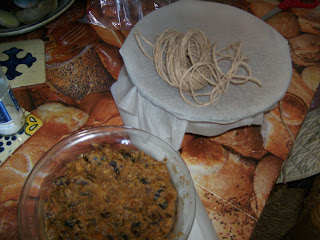


Old trusty recipe. Half made up, half copied from various books. Thoroughly imprecise. Vague quantities.


Fruit, spices, more fruit, candied peels. The sherry is mine. I've nearly ran out and forgot to order more supplies. I'm worried I won't last the winter.


The traditional family stir up. Efes dark in the background. That's Guinness substitute to you.

Glass bowls, some grease proof paper and a bit of string.

We decided to use one and a half time the quantities, for some reason we ended up with twice as many puddings. There's very little logic in puddings.
26/11/2011
The shocking truth about Marie-Antoinette, by the hon. Edmund Burke.
August 1795, London.
It is with great sorrow that I find myself obligated to report, for the sake of posterity, on a grave but thoroughly excusable mistake I have made. I am, I most shamefully admit, too much of a coward to share my recent observations with my own colleagues. The queen has been executed, and I do not want to sacrifice my reputation along with hers. I can still do some good for my country by holding the values I have always defended against those who would throw us into a senseless and bloody uprising.
It has come to my notice via a certain friend of my old enemy Price, that it was possible to publish one's thoughts for posterity without fear that they would be known during my lifetime. Though I am ignorant of the mechanics I have no choice but to avail myself of this method.
It is with great sorrow that I find myself obligated to report, for the sake of posterity, on a grave but thoroughly excusable mistake I have made. I am, I most shamefully admit, too much of a coward to share my recent observations with my own colleagues. The queen has been executed, and I do not want to sacrifice my reputation along with hers. I can still do some good for my country by holding the values I have always defended against those who would throw us into a senseless and bloody uprising.
It has come to my notice via a certain friend of my old enemy Price, that it was possible to publish one's thoughts for posterity without fear that they would be known during my lifetime. Though I am ignorant of the mechanics I have no choice but to avail myself of this method.
20/11/2011
Portrait of Autism #18
'He's not autistic', he tells me, three
lines into our conversation.
It's my son, he's talking about, not his
own, the three-year-old struggling to escape from his father's grasp
so he can slide down to play on the floor. Not quite his business,
you may think. Except of course, that I'm at the special education centre, where autism
is everybody's business. He tries to explain, but he struggles, as
his English is not what it used to be – he studied at an English
language university, as I know from a previous meeting. Max can
speak, he wants to say, he's friendly, so he's not autistic. I point out that even
now that Max has made so much progress, we're still experiencing
quite a few difficulties related to his autism. The fact that if the
slightest thing freaks him out at school he refuses to go the next
day, and is incapable of telling us why. The fact that he still has
temper tantrums that make us worry the neighbours will report us to
security, again. The fact that the rare conversations we have with
him are only ever about what he's drawing or transportation, who
lives where and where we're going to on holiday. Not that I'm
complaining: it's wonderful that he can speak at all, the tantrums
are a fraction of what they used to be and he goes to school often
enough that he's actually learning stuff.
19/11/2011
A very zombie love affair
After a long silence, we hear again from our eighteenth century correspondent, Mary Wollstonecraft who has much to relate of her philosophical progress since she last wrote here.
I am sitting down to write this
half-way between Paris and Lille which I hope to reach before
tomorrow night. I am tired from the journey, and being with child has
affected my capacity to reminisce – nonetheless, dear loyal reader,
I will now attempt to bring back with words some of the painful
events that have plagued me since I last wrote here.
'Tis two years now since I fled infected
London for Paris – two wonderful, peaceful years, when the only
upsetting events were the occasional loss of a dear friend to the
guillotine. 'Tis in Paris that I met my dear beloved Imlay, adored
companion and father of my child to be. France is mercifully free of
zombies. I believe the revolutionary practice of using the guillotine
often and plenty has so far prevented a general infection of the
country: the blade that slices through the neck is democratic enough in that
it kills zombies and royalists alike. M. Guillotine, I should note,
was one of the early proponents of the view to which I fully
subscribe that in order to destroy a zombie and prevent it from
rising again, one should separate its head from its body.
16/11/2011
08/11/2011
First catch your pumpkin: a recipe.
I' ve always felt a bit iffy about recipes that start with 'First, catch a rabbit'. I think Mrs. B used it, but given she was a London journalist, and she' d never set foot any where she could have caught a rabbit, one would be justified in thinking it was done for show.
So for readers who feel as I do, I apologise for this extravaganza.
First catch a bus, from the Ankara bus station, ASTI, in the direction of Nevsehir. At Nevsehir, get into a smaller bus to Goreme. When you get off, walk to your hotel, greet the owners like the old friends they have become, dump your bags, and go off for a restorative meal and walk.

The next day, hop into a minibus, driven by an even older friend, Zekerya bey, leaving the kids to sit at the back with his daughter, and enjoying the view. Drive south. Make your first stop at the market in Urgup. Feel a bit sad at the sight of the cows and sheep lined up for the coming sacrifice (Kurban Bayram), reflect that they've got it easier than the cows whose bits you buy in the supermarket most week. Let go.

Look at weird stuff, get daughter to ask what it is, taste it - like stewed apples, she says - buy a little, 'cause what the hell. The leaves make good tea, they say.
Study grapes, ripening in wooden crates, lettuces, lined up like wallpaper, nuts, herbs and spices in rolled up vinyl bags. No apples thanks, we'll pick our own, later.


Settle on a pumpkin vendor, ask his price: 1tl a kilo. This small one is three kilos - that's cheap and not too big to carry back.

They have olives! Husband is excited. He thought he'd missed the olive season. Not the olives in jars season, you understand: the raw olive season. He likes to prepare them himself in brine. We buy four kilos.

Next get everything back in the minibus. Drive some more. Stop off to look at some old stone with writing on it. It's not in any of our guides, we've never heard of it before, and have no idea what the writing is. Some really strange hieroglyphs.

A couple more stops: a prehistoric village with houses you can climb into, a monster of a church with Byzantine pretensions, surrounded by a huge monastery complex dug into the stone. No one around: again, this is not in any of our guides.

Our final destination: Soganli. Zekerya bey calls the restaurant ahead to tell them we're coming. They're crowded with two tour groups: but they'll make room for us, we come this time every year.
Out of the bus we fall, Max carrying a huge empty Safeway shopping bag.
The tables are set indoors. Normally we eat in the orchard but it's bloody freezing. But before lunch the ritual. Zekeya shakes the apple trees. The fruit falls every where and the children run and gather it in Max's bag. Zekerya and the restaurant owner cry: 'more! more!'

Bring the bag home after the holiday: fifteen kilos of apples, a pumpkin, some olives, and other essentials.

Carve the pumpkin for Halloween. Use the flesh for a soup, and for a pie.
Put a handful of flesh in a pan with a spoonful of water. Heat it a bit. Don't burn.

Wizz it with a hand mixer. Bang it in the fridge till you need it - it should keep a couple of days.
Mix a small carton of cream with the pumpkin. Add cinammon, crushed allspice, and grate what may or may not be mace into it. Add a bit of sugar, not much.
Prepare a crust: 200 g of white flour, 120g of cold butter, a couple of spoonfuls of sugar and a bit of salt. If you use gluten-free flour, add an egg yolk. Mix with your fingers and don't be ages about it. Add a bit of cold water, roll it, flatten it on some grease proof paper, put the greased pie dish on top, turn it over and make it fit.
Add the pumpkin mix, bang in the oven for about half hour. Take it out to cool, well out of the way of the cat. Eat.

So for readers who feel as I do, I apologise for this extravaganza.
First catch a bus, from the Ankara bus station, ASTI, in the direction of Nevsehir. At Nevsehir, get into a smaller bus to Goreme. When you get off, walk to your hotel, greet the owners like the old friends they have become, dump your bags, and go off for a restorative meal and walk.

The next day, hop into a minibus, driven by an even older friend, Zekerya bey, leaving the kids to sit at the back with his daughter, and enjoying the view. Drive south. Make your first stop at the market in Urgup. Feel a bit sad at the sight of the cows and sheep lined up for the coming sacrifice (Kurban Bayram), reflect that they've got it easier than the cows whose bits you buy in the supermarket most week. Let go.

Look at weird stuff, get daughter to ask what it is, taste it - like stewed apples, she says - buy a little, 'cause what the hell. The leaves make good tea, they say.
Study grapes, ripening in wooden crates, lettuces, lined up like wallpaper, nuts, herbs and spices in rolled up vinyl bags. No apples thanks, we'll pick our own, later.


Settle on a pumpkin vendor, ask his price: 1tl a kilo. This small one is three kilos - that's cheap and not too big to carry back.

They have olives! Husband is excited. He thought he'd missed the olive season. Not the olives in jars season, you understand: the raw olive season. He likes to prepare them himself in brine. We buy four kilos.

Next get everything back in the minibus. Drive some more. Stop off to look at some old stone with writing on it. It's not in any of our guides, we've never heard of it before, and have no idea what the writing is. Some really strange hieroglyphs.

A couple more stops: a prehistoric village with houses you can climb into, a monster of a church with Byzantine pretensions, surrounded by a huge monastery complex dug into the stone. No one around: again, this is not in any of our guides.

Our final destination: Soganli. Zekerya bey calls the restaurant ahead to tell them we're coming. They're crowded with two tour groups: but they'll make room for us, we come this time every year.
Out of the bus we fall, Max carrying a huge empty Safeway shopping bag.
The tables are set indoors. Normally we eat in the orchard but it's bloody freezing. But before lunch the ritual. Zekeya shakes the apple trees. The fruit falls every where and the children run and gather it in Max's bag. Zekerya and the restaurant owner cry: 'more! more!'

Bring the bag home after the holiday: fifteen kilos of apples, a pumpkin, some olives, and other essentials.

Carve the pumpkin for Halloween. Use the flesh for a soup, and for a pie.
Put a handful of flesh in a pan with a spoonful of water. Heat it a bit. Don't burn.

Wizz it with a hand mixer. Bang it in the fridge till you need it - it should keep a couple of days.
Mix a small carton of cream with the pumpkin. Add cinammon, crushed allspice, and grate what may or may not be mace into it. Add a bit of sugar, not much.
Prepare a crust: 200 g of white flour, 120g of cold butter, a couple of spoonfuls of sugar and a bit of salt. If you use gluten-free flour, add an egg yolk. Mix with your fingers and don't be ages about it. Add a bit of cold water, roll it, flatten it on some grease proof paper, put the greased pie dish on top, turn it over and make it fit.
Add the pumpkin mix, bang in the oven for about half hour. Take it out to cool, well out of the way of the cat. Eat.

01/11/2011
The Piano Tuner: a Halloween Tale.
- 'Shall we watch a horror movie? I ask. It's Halloween. It's what grown ups are supposed to do.'
- 'No.' He says.
He's wet, I think. Afraid he'll have nightmares.
- 'Fine.' I say, resigned. 'Let's go to bed, then.'
He looks up from his laptop:
- 'Coming. Leave a note for the piano tuner, will you?'
He doesn't mean anything by that. He said it as he sometimes says: 'Don't forget to put the tiger out'. I ignore him: our tiger is very small and it is not allowed out.
In bed, he says it again.
- 'Did you leave a note for the piano tuner?'
So I decide to tease. Is the piano tuner, I ask, a zombie freshly dug out of the grave to eat our brains while we sleep? Is he a vampire, who will knock on our door once and wait politely to be invited, before he bleeds us to death? Is he perhaps an escaped lunatic, carrying with him the dripping head of his previous victim in one hand and a long shiny knife to kill us in the other? Or is Freddy Krueger, with knives for fingers, a rotten face and an old stinky hat, waiting till we drop off to get us in our dreams? Is the piano tuner a small creature with a bent back and a hooked nose and piercing red eyes, who'll paralyse us with his spit and peel off our skin while we watch? Is he a small child with empty eyes, who will send us crashing to the ceiling with his supernatural strength? An old woman with an axe and a mad determined look on her face? Or a doll, even, a clown, anything at all, that I can summon from the films you don't want to watch with me?'
- 'Go to sleep.' he says.
But now I can't. The piano tuner is coming. I don't know what he is, but I know I should not close my eyes, or he will come for sure. I mustn't get up to check I've locked the door. Walking alone in a dark corridor is not recommended in this scenario. I might as well invite him in. Or go investigate a noise in dark attic by myself. Or find help where I might normally expect it. I look down at the shape of my husband's neck and head, half under the cover. Can I be sure it's him? I wake him just in case. I need to check. I look deep into his sleepy eyes. I have a vague memory that sometimes in films husbands get possessed by evil aliens. Better not to look too hard, then. If I'm lucky he'll wait till I'm fast asleep to murder me. Ignorance is bliss. I would rather die in my sleep. Painlessly, even, maybe.
But in the end, it is painful. I hear footsteps. My arms and legs are pinned to the bed by needles, knives and stakes. I try to hide under the cover, but again it comes for me. I manage to free a leg and I kick. The thing screams an unholy scream. It's a devil, now I know. Can I find enough strength to wake my husband and tell him to find a priest, an Italian, just like in the Exorcist? I fear he may be possessed already, as he's still fast asleep. I steal myself for more pain. I feel it moving towards my head. Will it enter through the mouth, the eyes, the ears? I close my eyes, shut my mouth, cover my ears and wait. And then it purrs. It was the tiger after all.
I put it out. I close the door.
- 'No.' He says.
He's wet, I think. Afraid he'll have nightmares.
- 'Fine.' I say, resigned. 'Let's go to bed, then.'
He looks up from his laptop:
- 'Coming. Leave a note for the piano tuner, will you?'
He doesn't mean anything by that. He said it as he sometimes says: 'Don't forget to put the tiger out'. I ignore him: our tiger is very small and it is not allowed out.
In bed, he says it again.
- 'Did you leave a note for the piano tuner?'
So I decide to tease. Is the piano tuner, I ask, a zombie freshly dug out of the grave to eat our brains while we sleep? Is he a vampire, who will knock on our door once and wait politely to be invited, before he bleeds us to death? Is he perhaps an escaped lunatic, carrying with him the dripping head of his previous victim in one hand and a long shiny knife to kill us in the other? Or is Freddy Krueger, with knives for fingers, a rotten face and an old stinky hat, waiting till we drop off to get us in our dreams? Is the piano tuner a small creature with a bent back and a hooked nose and piercing red eyes, who'll paralyse us with his spit and peel off our skin while we watch? Is he a small child with empty eyes, who will send us crashing to the ceiling with his supernatural strength? An old woman with an axe and a mad determined look on her face? Or a doll, even, a clown, anything at all, that I can summon from the films you don't want to watch with me?'
- 'Go to sleep.' he says.
But now I can't. The piano tuner is coming. I don't know what he is, but I know I should not close my eyes, or he will come for sure. I mustn't get up to check I've locked the door. Walking alone in a dark corridor is not recommended in this scenario. I might as well invite him in. Or go investigate a noise in dark attic by myself. Or find help where I might normally expect it. I look down at the shape of my husband's neck and head, half under the cover. Can I be sure it's him? I wake him just in case. I need to check. I look deep into his sleepy eyes. I have a vague memory that sometimes in films husbands get possessed by evil aliens. Better not to look too hard, then. If I'm lucky he'll wait till I'm fast asleep to murder me. Ignorance is bliss. I would rather die in my sleep. Painlessly, even, maybe.
But in the end, it is painful. I hear footsteps. My arms and legs are pinned to the bed by needles, knives and stakes. I try to hide under the cover, but again it comes for me. I manage to free a leg and I kick. The thing screams an unholy scream. It's a devil, now I know. Can I find enough strength to wake my husband and tell him to find a priest, an Italian, just like in the Exorcist? I fear he may be possessed already, as he's still fast asleep. I steal myself for more pain. I feel it moving towards my head. Will it enter through the mouth, the eyes, the ears? I close my eyes, shut my mouth, cover my ears and wait. And then it purrs. It was the tiger after all.
I put it out. I close the door.
13/09/2011
All I can do...
A couple of years ago, Rachel Cohen-Ruttenberg wrote on her blog about Simon Baron-Cohen's claims regarding empathy and autism. You're wrong, she said. Autistic people do have empathy. In fact, they very often have too much, which leads to a sort of paralysis of response. What do you do when the outside world is seeping through every pore of your being? You just close down. Now, Rachel know what she's talking about: she's autistic herself. Also, her argument has the merit of making sense, whereas SBC's arguments only really hang together because they tie with well accepted cultural stereoptypes, such as: boys like cars and don't communicate. Girls like dolls and talk all the time.
But Simon Baron-Cohen is not a snob, no, not he. So he agreed not only to read Rachel's post, but to respond to it as a guest poster in a blog.
Unfortunately, as he is a scientist, his hands were somewhat tied. All the poor man can do is 'look at the evidence'. And that evidence points clearly in the opposite direction of Rachel's own experience or that of other autistic people writing for her blog "Autism and Empathy".
And that evidence is first rate: SBC has asked a lot of autistic people, non autistic people and their parents to fill in a questionaire, asking them how empathic they are! This questionaire even has a proper scientific name: the AQ for autism quotient. And the you can find it on the web to find out if you are autistic.
So sorry Rachel and every one else: we simply cannot disregard this evidence.

But Simon Baron-Cohen is not a snob, no, not he. So he agreed not only to read Rachel's post, but to respond to it as a guest poster in a blog.
Unfortunately, as he is a scientist, his hands were somewhat tied. All the poor man can do is 'look at the evidence'. And that evidence points clearly in the opposite direction of Rachel's own experience or that of other autistic people writing for her blog "Autism and Empathy".
And that evidence is first rate: SBC has asked a lot of autistic people, non autistic people and their parents to fill in a questionaire, asking them how empathic they are! This questionaire even has a proper scientific name: the AQ for autism quotient. And the you can find it on the web to find out if you are autistic.
So sorry Rachel and every one else: we simply cannot disregard this evidence.

18/08/2011
Some day, people will say I didn't write my own books.
I've been digging into the x-chromosome side of the history of philosophy lately. As soon as my manuscript on Mary Wollstonecraft (without zombies) was off to the publishers, I started reading Christine de Pizan. Then I had a bright idea and went further back. I knew that Abelard was studied in courses on Medieval philosophy. What about Heloise, his correspondent? And then I went a bit further down. Plato had female students - did any of them, or any other women in the ancient world, write anything philosophical?
I'd like to say I hit gold - but it would be slightly off the mark. There just aren't many writings by women philosophers before Christine de Pizan. And not many afterwards either until the seventeenth century, when every princess worth her salt started taking on Descartes, and a few English eccentrics wrote metaphysical treatises of their own. Then, gradually, there's an increase in the female branch of the family, and now we make up nearly 20% of the profession! Hurrah! In another three or four centuries, we might actually reach equal proportions. Never lose hope.
I've ranted before about why there aren't that many women philosophers, listing several reasons, none of them have to do with women not being good enough. But I think I may have come across yet another reason.
Reading up on the Abelard and Heloise literature, I found very little analysis of what Heloise had to say. Instead, authors questioned whether she'd written the letters herself. Was the whole correspondence a forgery from the author of Le Roman de la Rose? Or did Abelard himself concoct them as a publicity stunt? Some more generous commentators suggest that maybe Abelard discussed with Heloise what her fake responses might be before he wrote them. The thought that Heloise was a highly educated woman, who taught Greek, Latin and Hebrew to the nuns in the convent she ran, did not dampen the of those wanting to write her out of philosophical history. Of course no one suggests that it's because she's a woman. No. It just so happens that the best use of some scholars' time is in coming up with arguments why Heloise couldn't have written these letters. It also turns out that these arguments don't hold much water - as a more careful scholar, John Marenbon, convincingly argues.
When I eventually located a text attributed to an Ancient Greek woman philosopher, I had the same experience. I quickly found myriads of poorly constructed arguments why she could not have written her own piece of philosophy. Granted, the writer bore the name of Plato's mum. Given there are no records of her being a philosopher, it stretches the imagination a bit far to think she was a well-known author. It doesn't stretch it as far to think she would have written a short text though, so I'm not sure it's worth getting one's knickers in a twist. But the texts themselves are discounted as forgeries by men writing some four centuries later. Again, the arguments are shoddy. And no one seems to even entertain the possibility that the forger, or pseudonymous writer, could have been a woman. I call it bad faith. I call it bad scholarship. I call it bad philosophy.
Telling 'Im indoors about all this at lunchtime, we pondered why and when this taking over of women's philosophical productions stopped. After all, he said, nobody is claiming that Wollstonecraft's or Simone de Beauvoir's books were written by men. I said that maybe that was because they were both active, public figures, who discussed their works with other writers, so that there could be no doubt about authorship. He replied that maybe these memories were still too fresh in our minds, but that a few centuries from now, people would again start questioning whether these works had not in fact been written by Godwin or Sartre.
Which brings me to the title of this post. How long till fragments of my books turn up in some archive and someone, bent on identifying obscure philosophers from the past decides that I couldn't have written them and attributes them to a male contemporary of mine? I suppose I won't be worrying about the royalties, then.
I'd like to say I hit gold - but it would be slightly off the mark. There just aren't many writings by women philosophers before Christine de Pizan. And not many afterwards either until the seventeenth century, when every princess worth her salt started taking on Descartes, and a few English eccentrics wrote metaphysical treatises of their own. Then, gradually, there's an increase in the female branch of the family, and now we make up nearly 20% of the profession! Hurrah! In another three or four centuries, we might actually reach equal proportions. Never lose hope.
I've ranted before about why there aren't that many women philosophers, listing several reasons, none of them have to do with women not being good enough. But I think I may have come across yet another reason.
Reading up on the Abelard and Heloise literature, I found very little analysis of what Heloise had to say. Instead, authors questioned whether she'd written the letters herself. Was the whole correspondence a forgery from the author of Le Roman de la Rose? Or did Abelard himself concoct them as a publicity stunt? Some more generous commentators suggest that maybe Abelard discussed with Heloise what her fake responses might be before he wrote them. The thought that Heloise was a highly educated woman, who taught Greek, Latin and Hebrew to the nuns in the convent she ran, did not dampen the of those wanting to write her out of philosophical history. Of course no one suggests that it's because she's a woman. No. It just so happens that the best use of some scholars' time is in coming up with arguments why Heloise couldn't have written these letters. It also turns out that these arguments don't hold much water - as a more careful scholar, John Marenbon, convincingly argues.
When I eventually located a text attributed to an Ancient Greek woman philosopher, I had the same experience. I quickly found myriads of poorly constructed arguments why she could not have written her own piece of philosophy. Granted, the writer bore the name of Plato's mum. Given there are no records of her being a philosopher, it stretches the imagination a bit far to think she was a well-known author. It doesn't stretch it as far to think she would have written a short text though, so I'm not sure it's worth getting one's knickers in a twist. But the texts themselves are discounted as forgeries by men writing some four centuries later. Again, the arguments are shoddy. And no one seems to even entertain the possibility that the forger, or pseudonymous writer, could have been a woman. I call it bad faith. I call it bad scholarship. I call it bad philosophy.
Telling 'Im indoors about all this at lunchtime, we pondered why and when this taking over of women's philosophical productions stopped. After all, he said, nobody is claiming that Wollstonecraft's or Simone de Beauvoir's books were written by men. I said that maybe that was because they were both active, public figures, who discussed their works with other writers, so that there could be no doubt about authorship. He replied that maybe these memories were still too fresh in our minds, but that a few centuries from now, people would again start questioning whether these works had not in fact been written by Godwin or Sartre.
Which brings me to the title of this post. How long till fragments of my books turn up in some archive and someone, bent on identifying obscure philosophers from the past decides that I couldn't have written them and attributes them to a male contemporary of mine? I suppose I won't be worrying about the royalties, then.
09/08/2011
A Welsh bestiary
Max is not big on animals. I often feel a twinge of envy ('Your kid's autism is better than mine'!?! - I know...) when I read about autistic kids who get help from having close relationships with dogs or horses. Max is just afraid of them. It's been a pain at times, as animals do get around. But mostly, I've felt that he missed out not only on fun with cuddly beasts, but on a whole learning experience that other children get from talking about nature.
Well, things did start to change for the better during our Welsh holiday last month. Max was on the whole calmer around animals, able to talk about them and learn from them.
He went fishing in rock pools with a little net: proudly caught a dead crab, all by himself, and marvelled at the tiny shrimp and catfish his daddy captured for him. He also enjoyed throwing them back in the sea, so we had no floaters to deal with.
During our cliff walk to Aberystwyth, we were able to talk about sheep, and how they give us wool, and cows and how they give us milk. A few days later we visited a fantasy farm and Max pulled on the udders of a plaster cow.
I took him to a small zoo where he was given a cup of raw veg and peanuts to feed the animals. He let me handle the actual feeding part of it, but was absolutely delighted to see the squirrels eat the nuts.
But his favourite creatures were definitely the gulls, despite the fact that there were so many of them, that they came very close to us, that they were loud and aggressive, he loved them. He sought them out, imitated their cry, and walked up close to them. A week before we went to Wales, he was still scared of pigeons.
Today, he told me he'd like to have a cat.
Oh, one last thing. If you liked this post, would you mind terribly clicking on the RSS feed, here, or the Google connect buttons (top left), or by email at the bottom of this page? And if you didn't like it, you might still want to look around. There's three of us, you know, so you're (almost) bound to find something you like. And then, if you've still got time, you could share this post or stumble it, or both and get in touch with your local tv station to sing our praises. We'll love you forever.
Well, things did start to change for the better during our Welsh holiday last month. Max was on the whole calmer around animals, able to talk about them and learn from them.
He went fishing in rock pools with a little net: proudly caught a dead crab, all by himself, and marvelled at the tiny shrimp and catfish his daddy captured for him. He also enjoyed throwing them back in the sea, so we had no floaters to deal with.
During our cliff walk to Aberystwyth, we were able to talk about sheep, and how they give us wool, and cows and how they give us milk. A few days later we visited a fantasy farm and Max pulled on the udders of a plaster cow.
I took him to a small zoo where he was given a cup of raw veg and peanuts to feed the animals. He let me handle the actual feeding part of it, but was absolutely delighted to see the squirrels eat the nuts.
But his favourite creatures were definitely the gulls, despite the fact that there were so many of them, that they came very close to us, that they were loud and aggressive, he loved them. He sought them out, imitated their cry, and walked up close to them. A week before we went to Wales, he was still scared of pigeons.
Today, he told me he'd like to have a cat.
 |
| A few bestial encounters. |
Oh, one last thing. If you liked this post, would you mind terribly clicking on the RSS feed, here, or the Google connect buttons (top left), or by email at the bottom of this page? And if you didn't like it, you might still want to look around. There's three of us, you know, so you're (almost) bound to find something you like. And then, if you've still got time, you could share this post or stumble it, or both and get in touch with your local tv station to sing our praises. We'll love you forever.
08/08/2011
What to do at the beach on a rainy day.
Ok, so going into the sea when it's cold and raining does get old. After the first day of our Welsh holiday, I made a social story for Max with a list of things we can do when we can't swim. I don't normally do list posts - that's Marianne's thing - and this isn't really a list, more of a heap.


Let's just say no-one got bored.
Oh, one last thing. If you liked this post, would you mind terribly clicking on the RSS feed, here, or the Google connect buttons (top left), or by email at the bottom of this page? And if you didn't like it, you might still want to look around. There's three of us, you know, so you're (almost) bound to find something you like. And then, if you've still got time, you could share this post or stumble it, or both and get in touch with your local tv station to sing our praises. We'll love you forever.
07/08/2011
First - and last - date
It had been a while since I hadn't been on a proper date. First of all, I'd been married for 10 years and living with the same guy for 5 more, so that's a total of 15 years without a date. Long time, eh?
I was freaking out. The guy - let's call him Robert, asked me out as we bumped into each other in the Paris metro. We hadn't seen each other in four years, chatted for a few minutes and he asked for my number, promising to call me a few days later. Right, I thought, he'll never call. I'm 34 and yet I still cannot tell when a guy will or will not call, I think it's pretty pathetic, but anyway. He called, of course (maybe I should strongly believe I am ALWAYS wrong and know, from now on, that men will do the exact opposite I think they will do. That should work!) and asked me out. On a date. As in, a real one. Restaurant and all. He even offered to pick me up at home.
I should have known something was wrong as I received the 15th text about where and when we should meet. Seriously. Pick a time and place, ask the woman if that's OK and go with it. It was flattering and sweet at first "Where would you like to go?" "I thought of this place, what do you think?", but then it got annoying. I'm not patient. There. I grow tired of people who do not know what they want.
I should have known something was wrong as I received the 15th text about where and when we should meet. Seriously. Pick a time and place, ask the woman if that's OK and go with it. It was flattering and sweet at first "Where would you like to go?" "I thought of this place, what do you think?", but then it got annoying. I'm not patient. There. I grow tired of people who do not know what they want.
Of course I bought a new outfit, spent an hour applying make-up and doing my hair, changed three times and swore a million times about said make-up, clothes and me being a fat cow. I think this was, by far, the best part of the date. I had forgotten the excitement of it all.
He arrived right on time and we walked to the restaurant. While we ate I begun to wonder if I hadn't been tricked or something: all Robert talked about was his ex-wife. By the end of the meal, I felt I knew her pretty well, now. What I did know for sure is that Robert was not over her.
He walked me home, the perfect gentleman. But for God's sake, it was the most boring evening ever. I was back home at 10pm. I called my girlfriends, took a cab and went off to have some actual fun in bars and clubs.
I thought he'd never call back but of course he did. I saw him once more (well, he was good looking and nice and clever, so I had to give him another chance) and it was just as disastrous. I had to tell him he was not ready. At least he agreed with me.
Dear Robert, I hope you'll be better at dating soon. What I know now is that your next date will not be with me ;)
Oh, one last thing. If you liked this post, would you mind terribly clicking on the RSS feed, here, or the Google connect buttons (top left), or by email at the bottom of this page? And if you didn't like it, you might still want to look around. There's three of us, you know, so you're (almost) bound to find something you like. And then, if you've still got time, you could share this post or stumble it, or both and get in touch with your local tv station to sing our praises. We'll love you forever.
Oh, one last thing. If you liked this post, would you mind terribly clicking on the RSS feed, here, or the Google connect buttons (top left), or by email at the bottom of this page? And if you didn't like it, you might still want to look around. There's three of us, you know, so you're (almost) bound to find something you like. And then, if you've still got time, you could share this post or stumble it, or both and get in touch with your local tv station to sing our praises. We'll love you forever.
06/08/2011
The cliff walk
The weather is turning. There is now more blue than grey in the sky and it looks as though it might get warm later on. That said, we're still avoiding spending time by the beach – yesterday we took the cliff top walk to Aberystwyth, today we're off to visit an Cistercian Abbey: Strata Florida.
The good weather is getting to everyone. Out of the window I just glimpsed an elderly man striding the beach in front of the cottages, a smile on his face and a bottle of rose in his hand.
The walk yesterday was more difficult than we'd anticipated, not because it was long or harduous – the climb was a bit steep at times but always you could walk it, rather than scramble. We're used to scrambling when we walk in Cappadokia. In fact, we're pretty much used to scrambling to the point where we have to go back because it's impossible and we probably took a wrong turn somewhere in the valley. The good thing about cliff walks is that it's fairly obvious where you should go. On the other hand, it's also pretty clear what would happen to you if you took a wrong turn, or if the children took a wrong turn. So it was a little nerve wracking and I pretty much had to drag Max all the way to Clarach (or some such thing) where we decided would be a good place to stop and ask for a lift – a mere four miles from where we started.


The good thing about having to stick close to Max is that we got to talk about what we saw a lot. I was able to teach him about how we get wool from sheep, and milk from cows which I think he understood. I also tried to explain that we ate the animals but couldn't think how to move his imagination from the large living thing to the plate of chili con carne. It was probably the first time he'd looked at a cow without cowering – he even baaaed at the sheep and moooed at the cows – so I didn't want to add pictures of slaughter to the mix.
We also saw a snail – not just a shell as we find in Ankara, but a living thing, out and about with its little horns poking out. And no, it wasn't the kind we eat, so I didn't bring that up. (I have a vivid memory of Marianne picking up a small yellow snail in our garden, and gobbling it up, thinking it was a sweet – she still loves snails.) We saw a moth with black, red-spotted wings. I wished I had a decent camera, then.

We stopped on a beach by a farm to eat our sandwiches. The farm was huge, resembling a small castle. White, and with a thick wall surrounding it. I thought of the farms I'd seen in Yorkshire, in particular the small pile of grey stone that had once been the inspiration for Wuthering Heights. Yorkshire was on my mind as the friend I'd called to pick us up at the next village had just moved from Leeds where we'd visited in previous years. How convenient, how thougthful of them to move right next door to a place where that is bound to become our new base in the UK. Thank you Hannah and Roger, for making our lives so easy.
Subscribe to:
Posts (Atom)
